Explainability and Clinical Trust of Deep Learning in Glioblastoma Treatment Response
Deep learning models can predict treatment response in glioblastoma from MRI with strong accuracy — but clinicians won’t trust a black box, and they shouldn’t. As a Research and Development Intern in Explainability at the Centre François Baclesse (03/03/2025–01/08/2025), I built a comprehensive auditing framework to find out why one such model was actually making its predictions, and whether that reasoning was clinically sound.
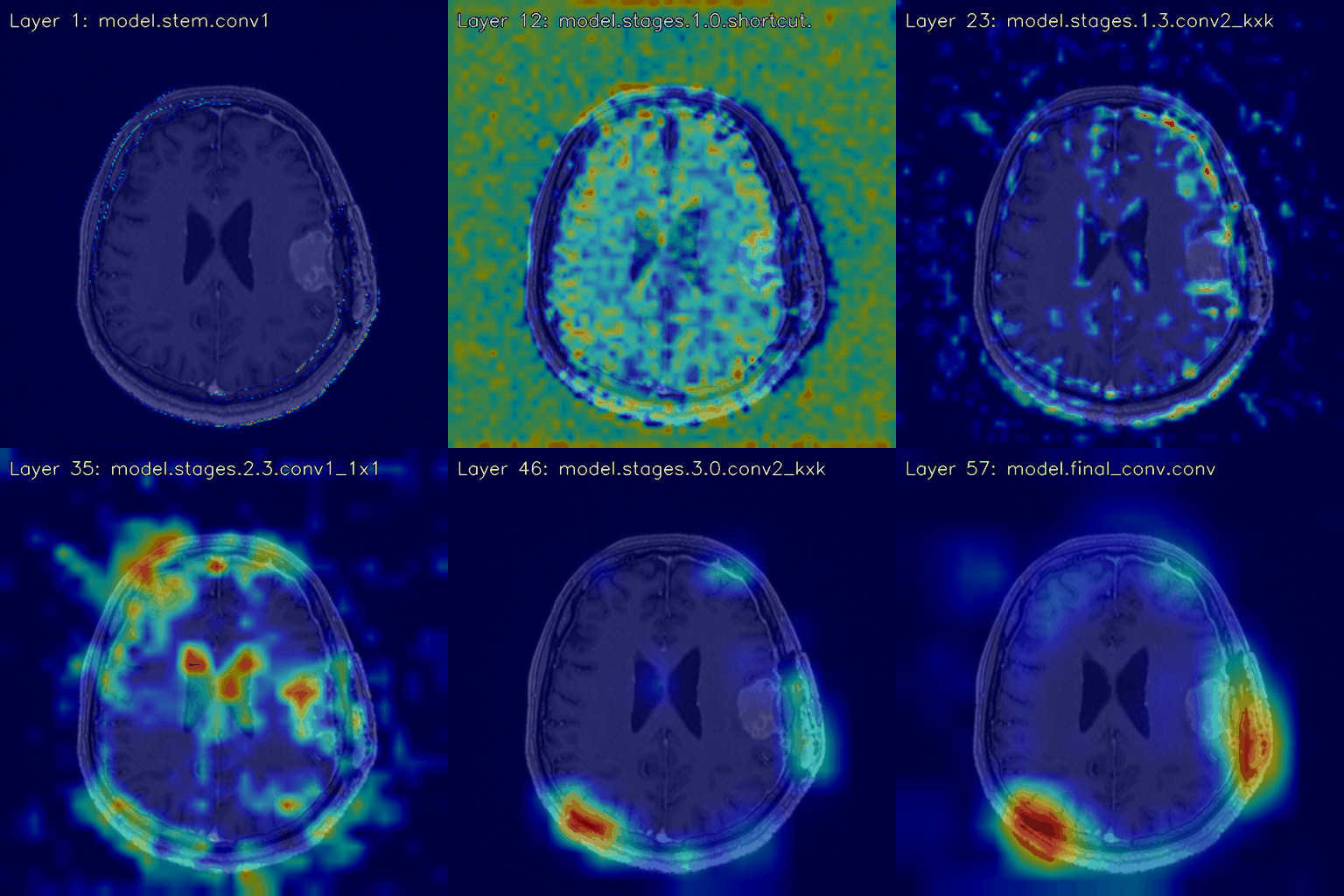
The pipeline
A multi-layered XAI audit of a ResNet-51q model trained to predict long- vs. short-survival treatment response:
- Grad-CAM and LRP for pixel/region-level saliency.
- LIME for local, model-agnostic explanations.
- Linear probing to test what information is linearly decodable from intermediate representations.
- Causal activation patching to test, interventionally, which activations the prediction actually depends on — not just which ones correlate with it.
What we found
The audit uncovered that the model was relying on an unexpected heuristic: a proxy for surgical resection status. Instead of anchoring its long- vs. short-survival predictions on tumoral features, the model had learned to detect the surgical site itself and use that as its main signal. This finding was confirmed through targeted ablation studies and high-resolution saliency maps, and the overall framework was validated in a multi-reader, multi-case clinical study — exactly the kind of shortcut-learning failure mode that makes explainability essential before deploying models like this clinically.
Outcome
This work is written up as a first-author manuscript, currently under review: “Explainability and Clinical Trust of Deep Learning in Glioblastoma Treatment Efficacy Prediction: A Comprehensive Framework” (Andres, R., Moreau, N., Dessoude, L., Le Henaff, L., Missohou, F., Stefan, D., Desmonts, A., Herault, R., & Corroyer-Dulmont, A., 2025). See the publications page for the full reference.
Stack: Python, PyTorch, Grad-CAM, LRP, LIME, linear probing, causal activation patching. Code: github.com/VendenIX/GBM-Treatment-Response-XAI
Enjoy Reading This Article?
Here are some more articles you might like to read next: